A Building Is a Language: A Conversation with Sean Zaudke
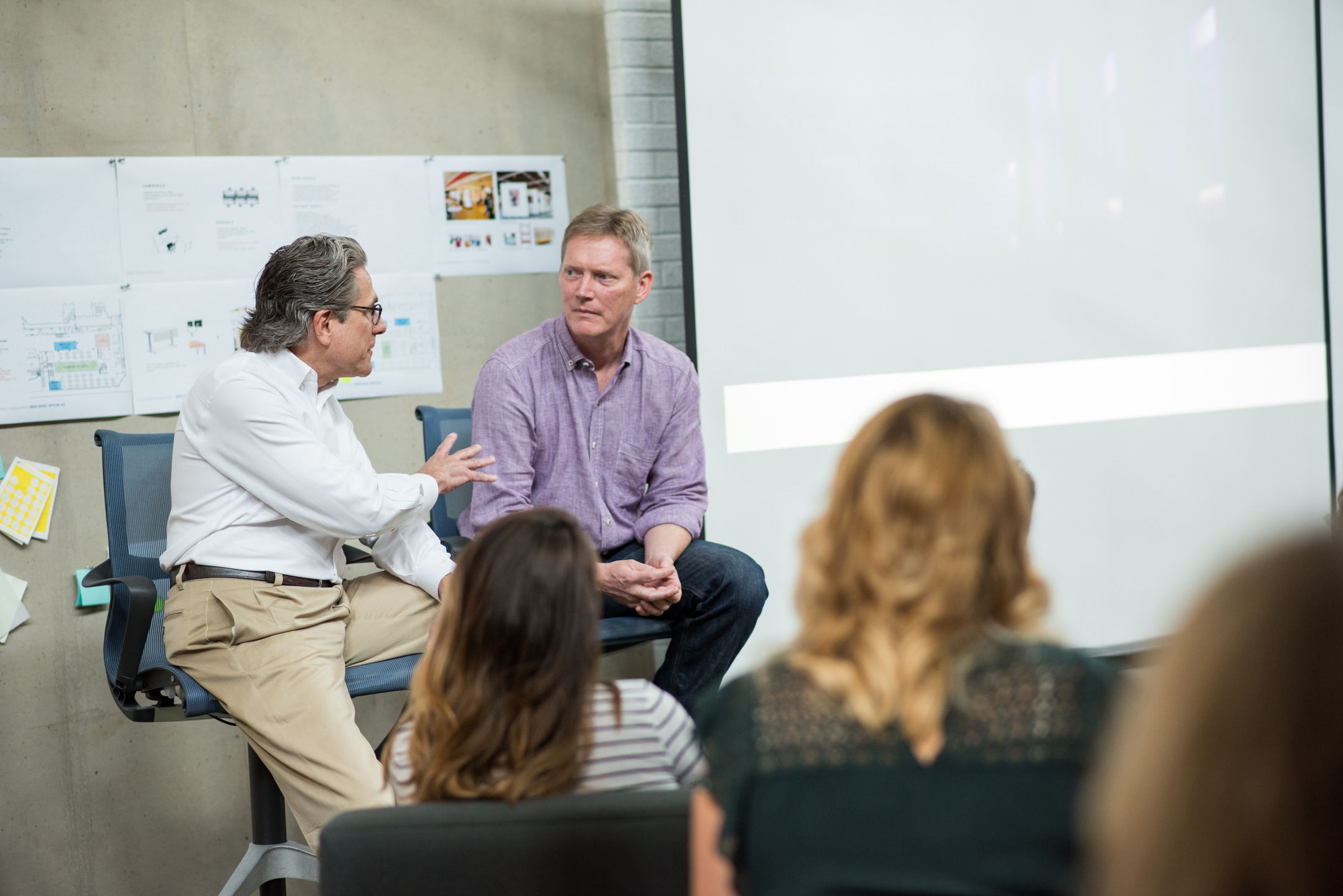
For nearly three decades, Multistudio Principal Sean Zaudke, AIA, LEED AP, has shaped civic, educational, and cultural work across the Midwest through a practice defined by technical rigor, design intelligence, and a deep regard for place. Based in our Kansas City studio, he brings a distinctly regional perspective to projects that must perform technically, reflect their unique contexts, and serve communities in authentic, lasting ways.
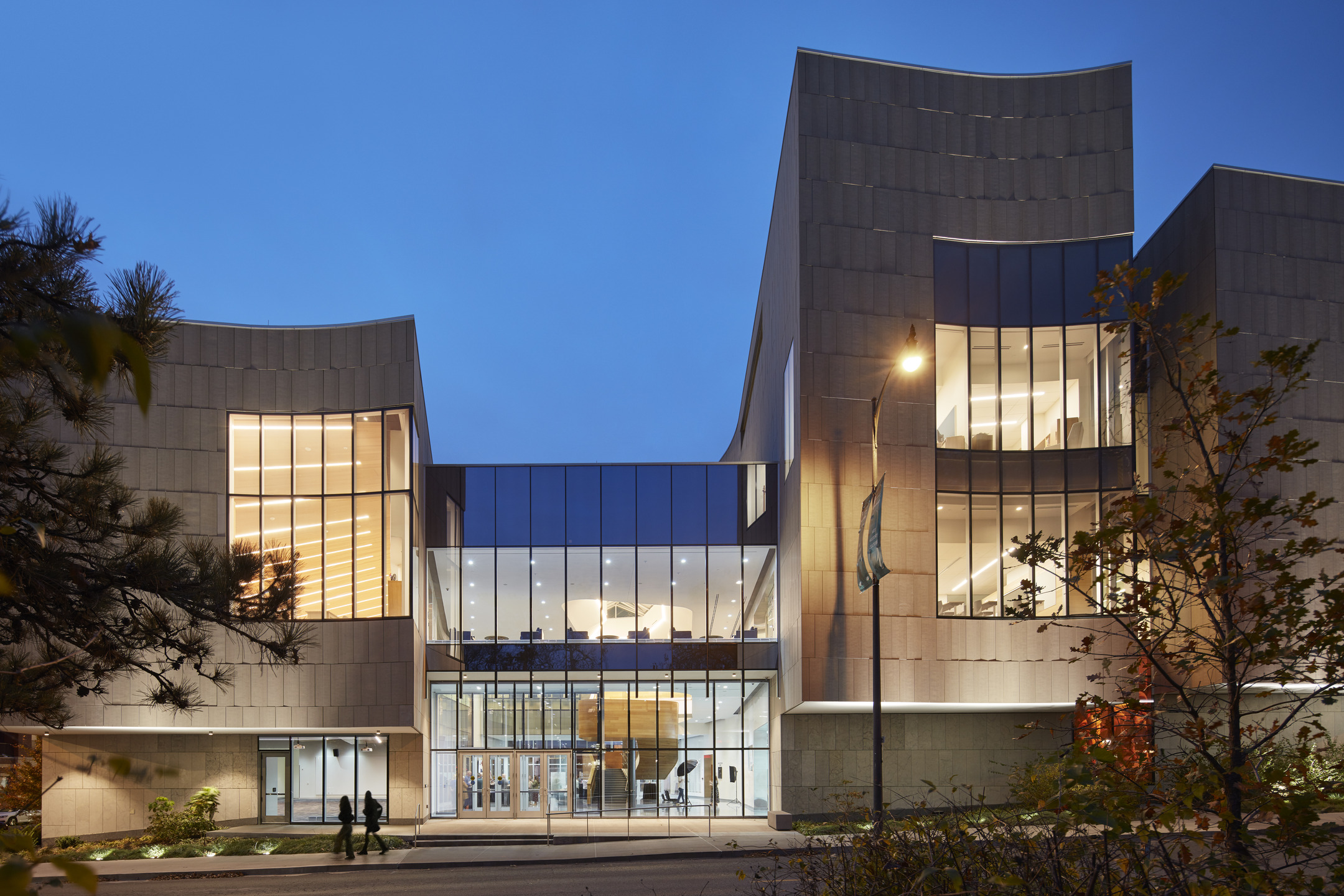
His portfolio includes award-winning public projects such as the State Historical Society of Missouri Center for Missouri Studies, recognized with a 2025 National AIA/ALA Library Building Award and a 2024 American Architecture Award from The Chicago Athenaeum: Museum of Architecture and Design, among other honors.
What distinguishes Zaudke’s work is his deep understanding of building systems and commitment to interdisciplinary thinking, paired with his generous, collaborative approach to uncovering stakeholder needs.
We sat down with Zaudke to discuss the evolution of his practice, the relationship between building systems and literary theory, and how his process continues to open new possibilities for design across the region.
SZ: My grandpa was a tinkerer. He worked with his hands, never went to college, and ended up becoming an aircraft mechanic at Boeing. He would solve things that no one else could figure out how to solve. He'd create new processes for fixing part of a jet, motor, or engine, and was known for that ability. I'd watch him as a child, and he'd tinker on his house and do things like tear a wall down. And I would sit there thinking, you can tear a wall down? I was amazed by the fact that he knew how to do all these things.
This really stuck with me. I wanted to know how to do something right, how to take something apart, and how it works. In my architectural work now, I see building systems as an intricate web of connectivity between walls, windows, roofs, mechanical systems, and more. I love the fact that we can know how a building performs inside and out from a technical perspective, and beyond that, how to optimize a building for the way it needs to function in our world today. We can pinpoint where moisture converts into vapor and condensation inside a wall. We know how a rain screen pulls moisture away from a building. The whole physics and science of buildings is fascinating to me.

SZ: There are certainly multiple levels of nuance to designing in the Midwest. At the most pragmatic level, we have a responsibility to address the environmental concerns of our region, and ask how we can design responsively to those challenges. There’s also a value proposition that's underlying every decision we make at Multistudio — whenever we work through a technical decision or a design decision, we ask ourselves, does this make sense here?
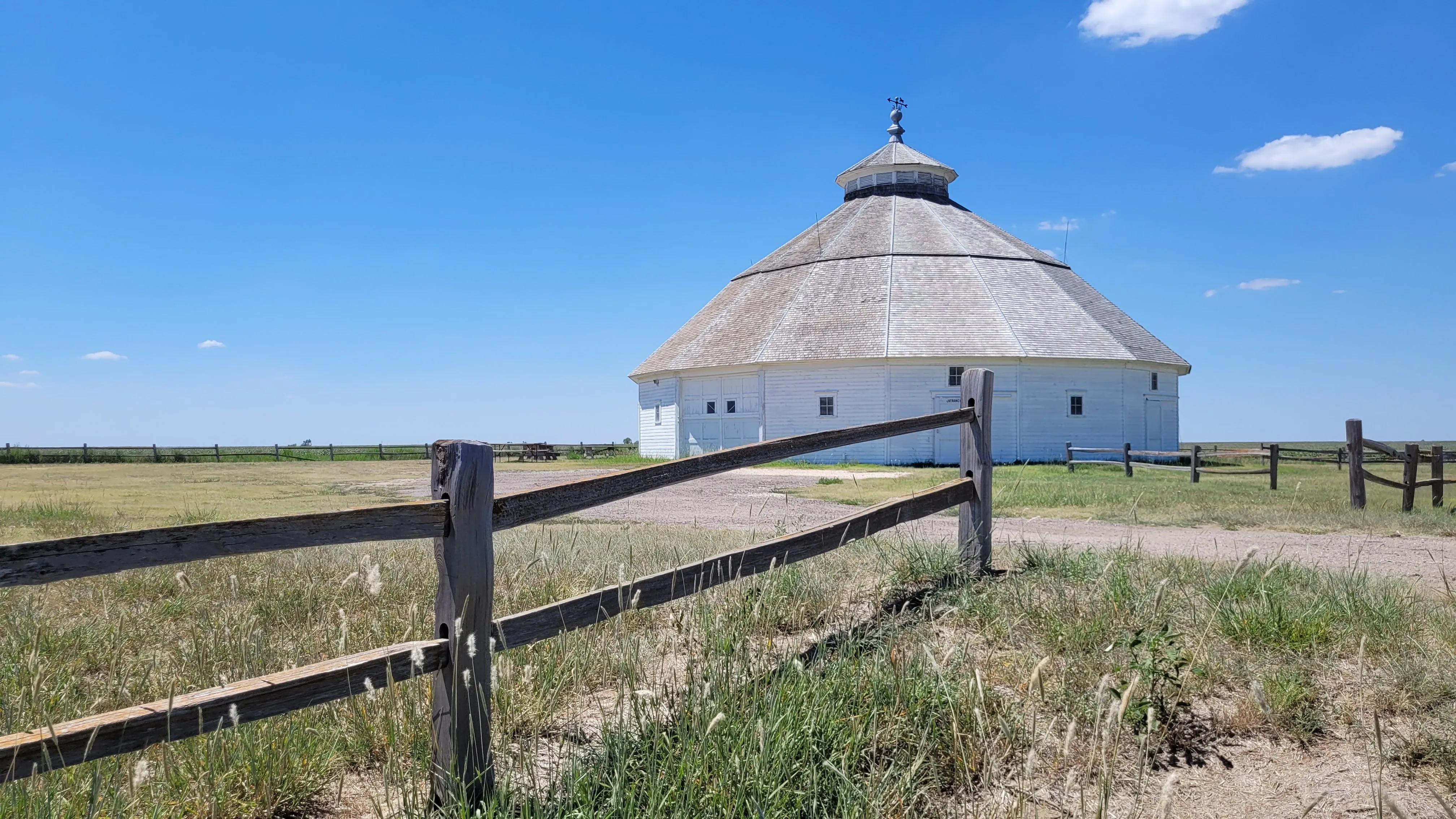
About 15 years ago, I was part of the AIA Design Board in Kansas, and I had written this essay on barns. I dislike the idea of touting barn design as a rubber stamp for being contextual within the Midwest. What is it about a barn, really? When we view barns as synonymous with our region, I think we’re actually communicating beyond the surface, to the pragmatic realities of how they're designed. I believe that’s where authenticity truly comes from. A design must be authentic and rooted in place, and that means ensuring it is completely justifiable and defensible on a practical and technical level. Does it keep water out? Are we creating the most tailored solution for our climate and values? Checking the box on a very fundamental level is imperative. Perhaps it should be a lens through which a client scrutinizes architects to ensure they’re able to do this work.
SZ: At Multistudio, we work contextually, so everything’s intertwined in my mind in terms of how we make decisions about buildings. I strongly believe that the components of a building are a language. When we design, we're communicating on multiple levels about what the building means for a community, how it functions, and how it resolves all kinds of basic needs. The more that we can fundamentally understand the pieces and parts of that language, the better we are able to create something meaningful for a community that has authenticity embedded at its heart.
SZ: In college, I was fascinated by literature. I tore through every bit of the modernist canon you could tie into, then moved on to post-structuralist authors, existentialists, and others. I'm a first-generation college student, and up to that point, I didn’t know anyone who went to college. So, when I got there, I was shocked to discover this world of literature that was available to me.
As an architecture student, my reading began to influence how I thought about building design. Three books were pivotal for me. The first was Complexity and Contradiction by Robert Venturi, which recognizes that things we take for granted in a building, a wall, a roof, a floor, or a window, can actually have more meaning than it seems, and that we can start to prescribe meaning to things like walls and roads, so they become a communicative device.
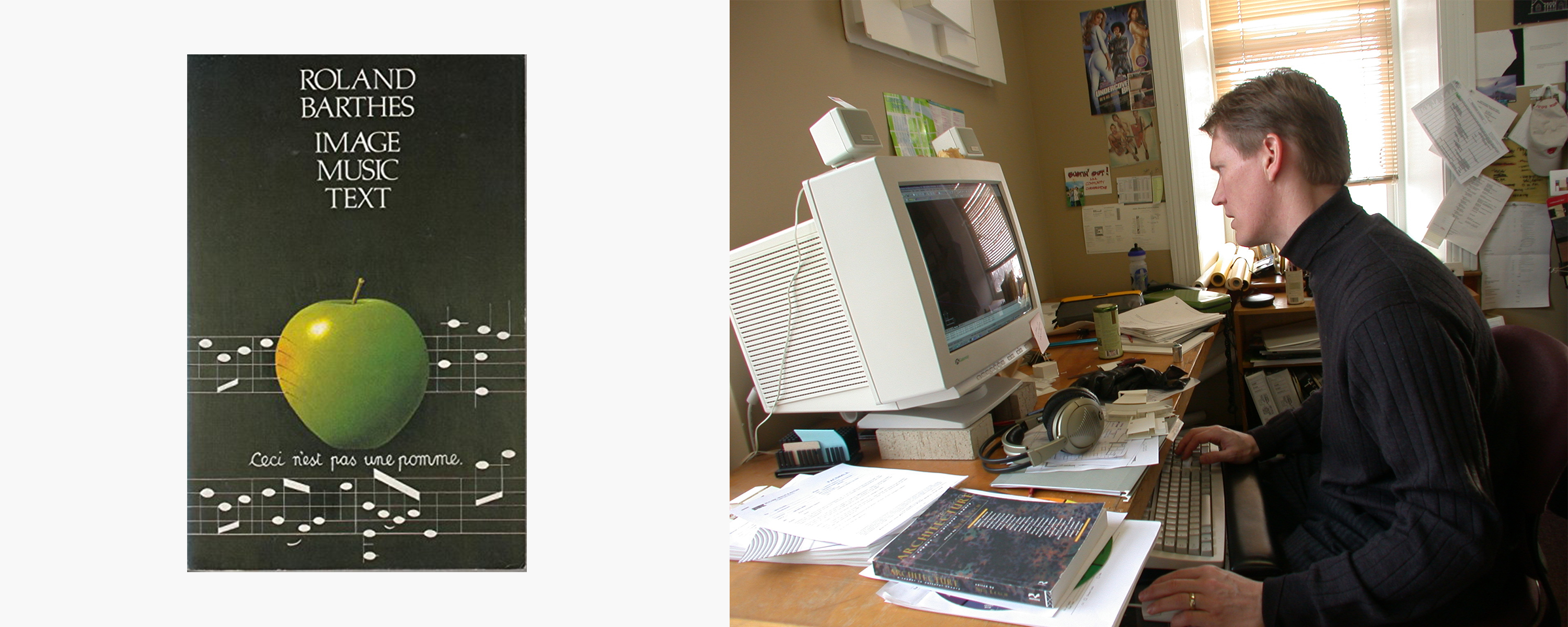
Second was Roland Barthes’ Image-Music-Text, in which he described the linguistic theory that a word, or signifier, we ascribe to a thing is arbitrary and not inherent. Words are just an approximation. I started to see that the elements of a building are also just as flexible and fluid. I began to think about building systems as more than things that make a building safe and operational.
Thirdly, I remember reading The Glass Bead Game by Herman Hesse, which was about a game in which the player finds underlying parallels between music, history, literature, mathematics, and other disparate forms of expression. The idea that you could find alignment in all of these was eye-opening to me. I started to see that a building element could be substituted for something like music, and I recognized the potential for loading so much more meaning into my design decisions.
SZ: My professors recommended that I go to grad school and teach. But when I got out of college, I decided to do the opposite. I worked as a contractor because I wanted to understand the basics of the language of building. So, I was pouring concrete and framing walls — very fundamental stuff. I really believe this experience gave me a strong underpinning in structural and architectural language. This has allowed me to design more efficiently and fluidly, and have confidence when I’ve created a solution. I was able to consider a broad range of ideas from macro to micro, from a consideration of the community down to technical details.
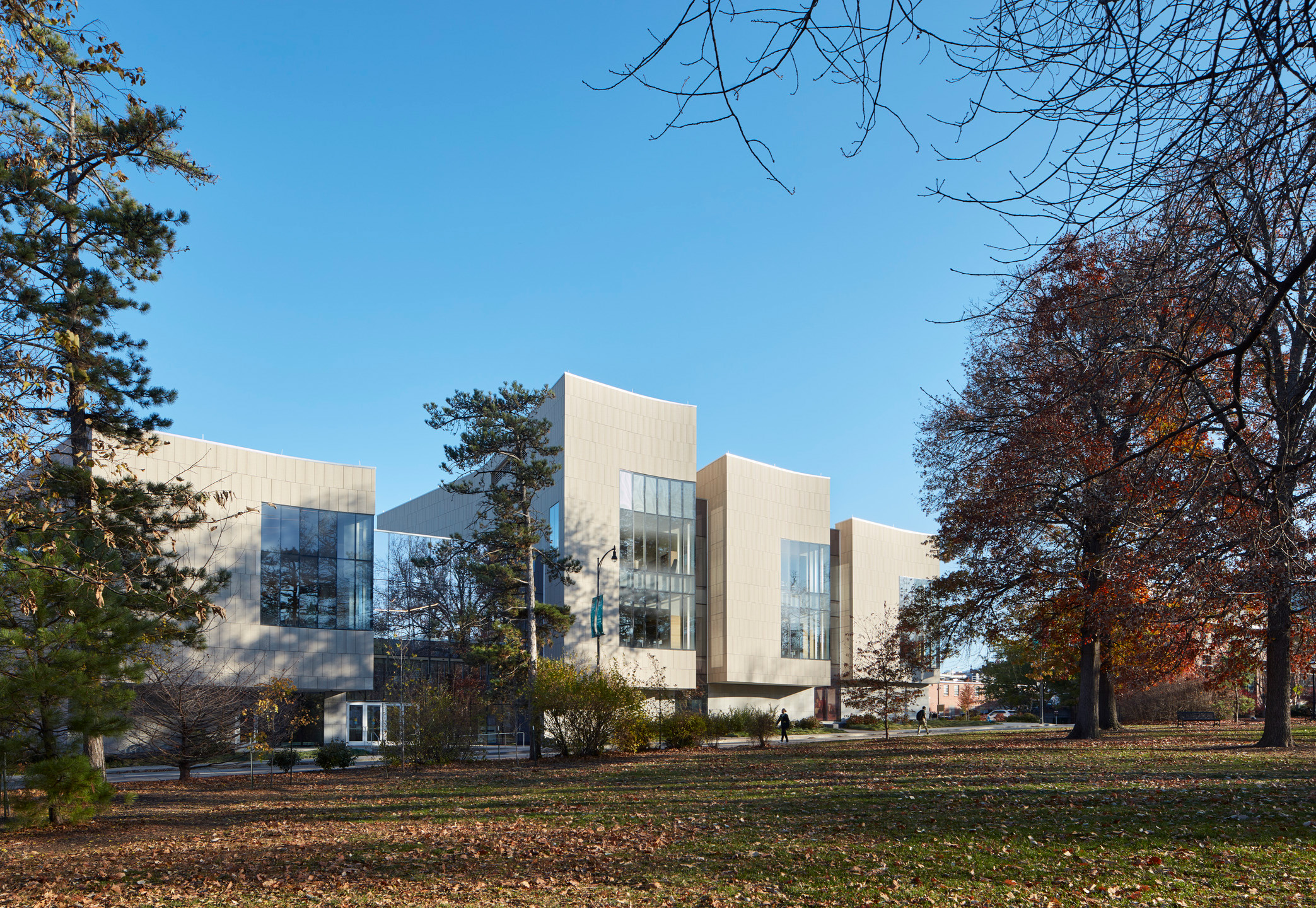
SZ: When we designed the State Historical Society of Missouri (SHSMO) Center for Missouri Studies, we moved away from commonplace design tropes, that this building would be “historical-looking,” or built with limestone and gables, perhaps a turret, punched openings, and big wooden doors.
The client wanted something iconic. They were very explicit about that. We asked, does that mean looking backwards, or does it mean to look toward who you are today? They told us that they wanted their interpretation of history to be a living thing. That living component became the core idea behind our design.

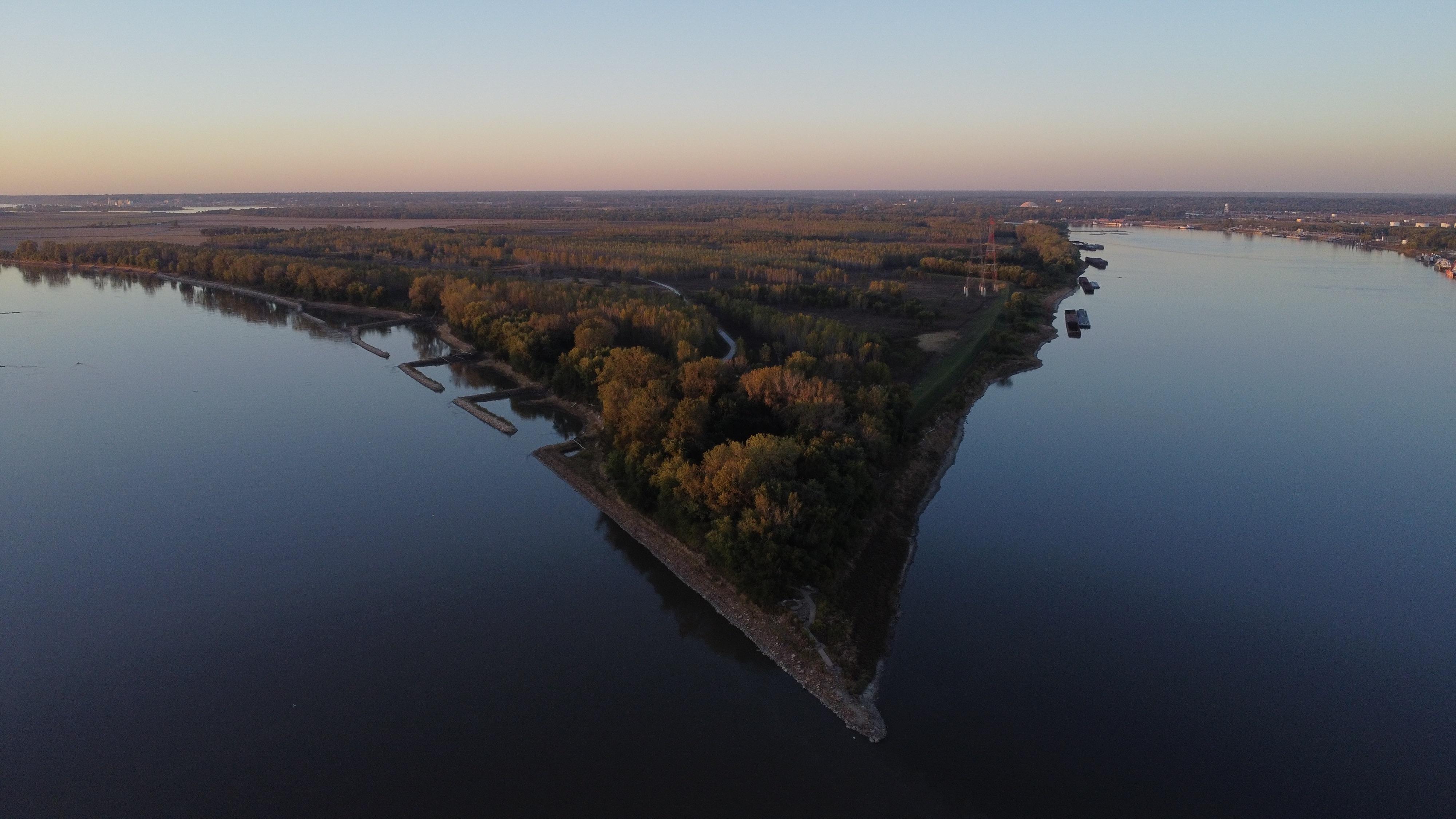
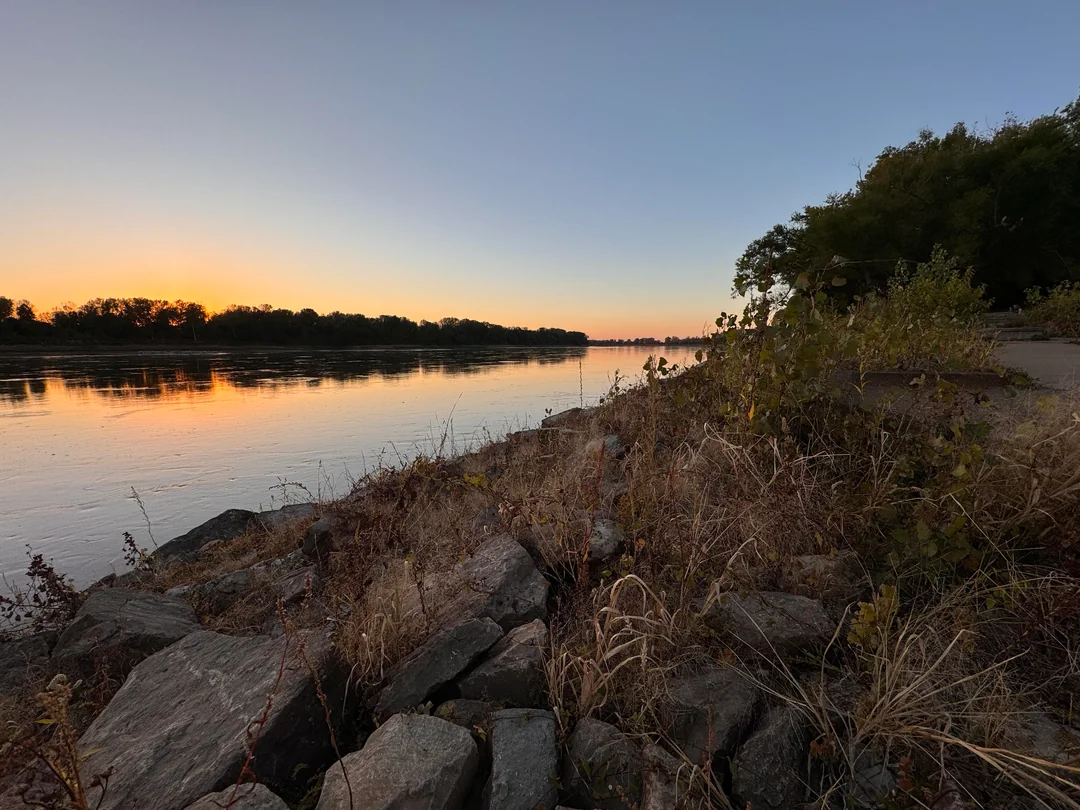
Our team dove into the history of Missouri, and we arrived at a pivotal part of Missouri’s identity: the confluence of the Mississippi and the Missouri rivers. These rivers create a north-south and east-west connection through the nation. Confluence has long brought people and ideas together, and it also became a way to describe the meeting of past and present together at a historical society, along with the fluid connection between a campus and a city. The project is a whole series of references and cues to river and water language.
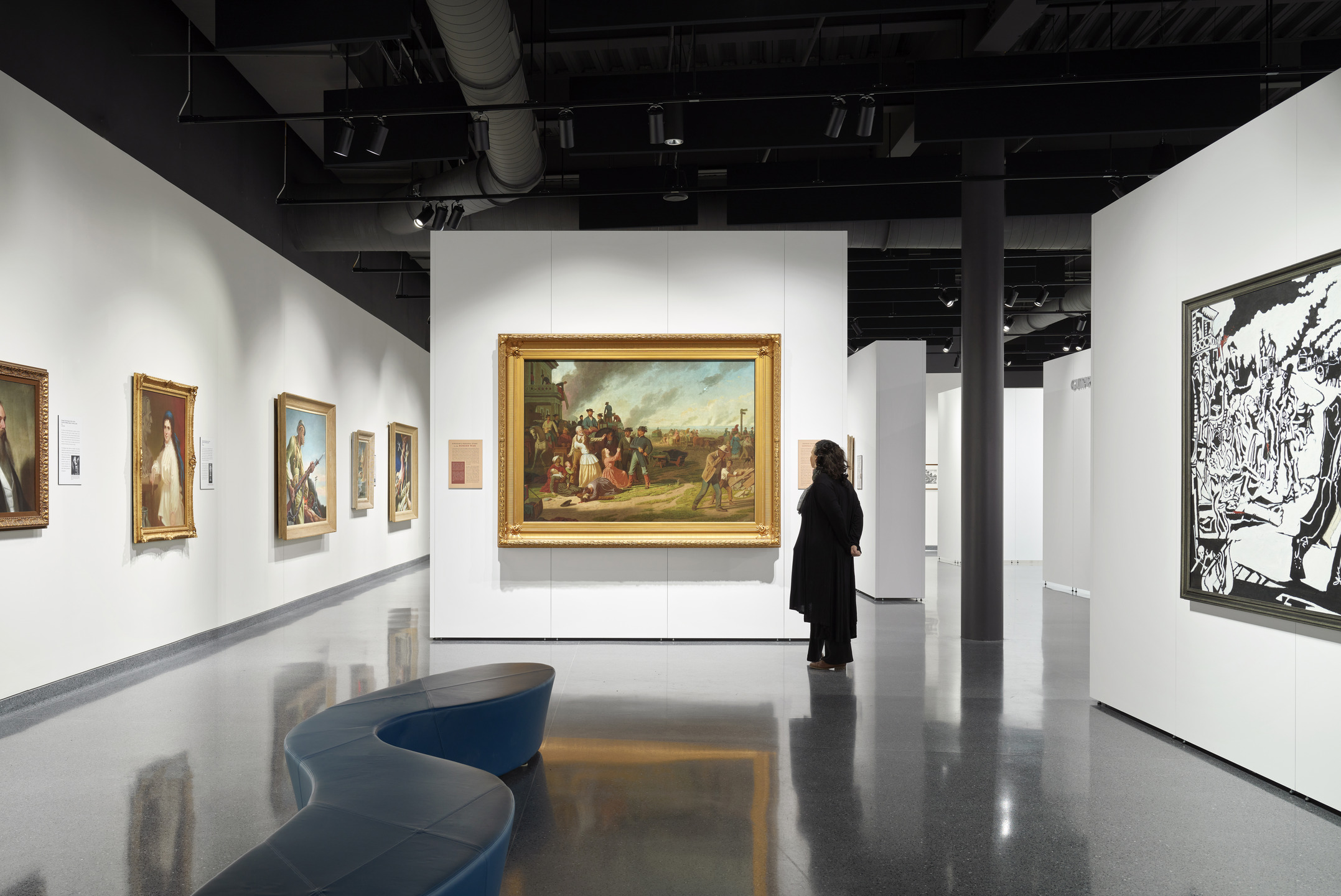
SHSMO’s art collection also became an opportunity for us to think about making meaning. We started to ask what it would be like to inhabit a painting from the collection. The central stair in the lobby of that space is the manifestation of this idea, inhabiting a Thomas Hart Benton painting. Another painter, George Caleb Bingham, was part of a group of artists called the Illuminists. They made these amazing paintings of boats, arriving out of and through the fog. You just see the image of a face appearing, and everything else is dark. I had this vision of the ripples of the facade arriving out of darkness. That's when we began to curve the face of the building. Using the language of curvilinear walls also created a sense of rippling water. This rippling at its center seemed to unify the art, literature, and contemporary dialogue within one central space.

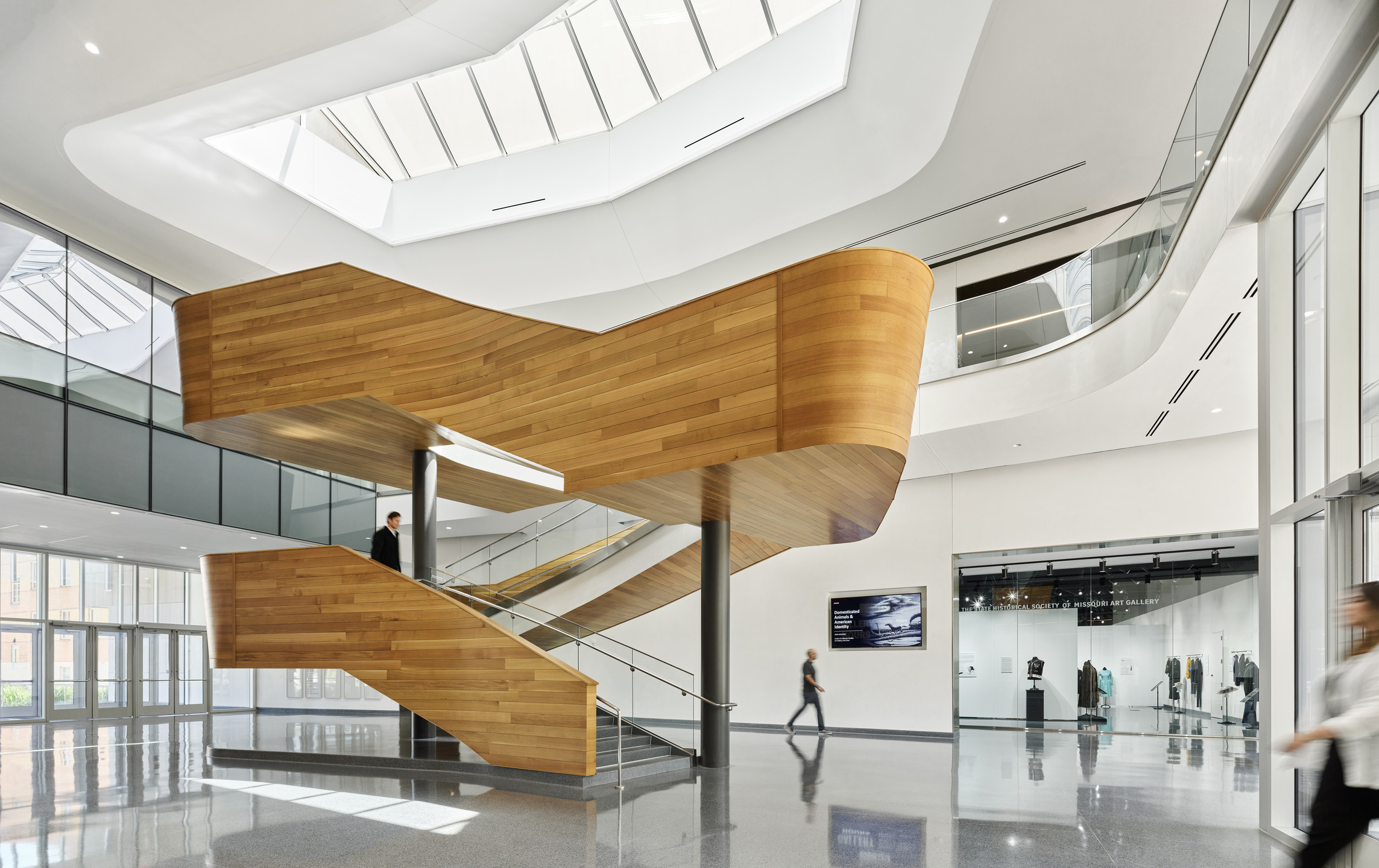
We also ensured there was technical alignment with the conceptual idea of confluence. We chased that down to the detail. The common way of designing a window is to set it inside the wall, put some flashing around it, and create this standard thing we’ve seen in buildings everywhere. But because our concept was about water and fluidity, we wanted to make this as taut a facade as we could. We removed from view all the flashing and connection points you would typically see on a project, so it produced a taut visual. It took us being technically creative about how to reinterpret the detail to pull that off.
SZ: I recently met with a Midwestern client who was saying that there’s a sentiment in the place where they live and work that they don't deserve to have good design: that's for other people in other places. There’s this baseline preconditioning in the Midwest to just grin and bear it.
But I fundamentally believe that we can democratize experience to create accessible beauty, meaning, and comfort. We should create places that feel good and safe to be in. There aren’t many of those places in the world. It’s our moral obligation as architects, as we are in one of the few professions that have the opportunity to create beneficial spaces for people.
This is especially true for civic projects, places where you don’t have to pay to enter them. You don’t even need a library card to go into a library. No one's going to hassle you. No one's going to ask you to leave. No one's going to ask you, do you believe this or will you buy this? You can just be there. It’s a very simple thing.
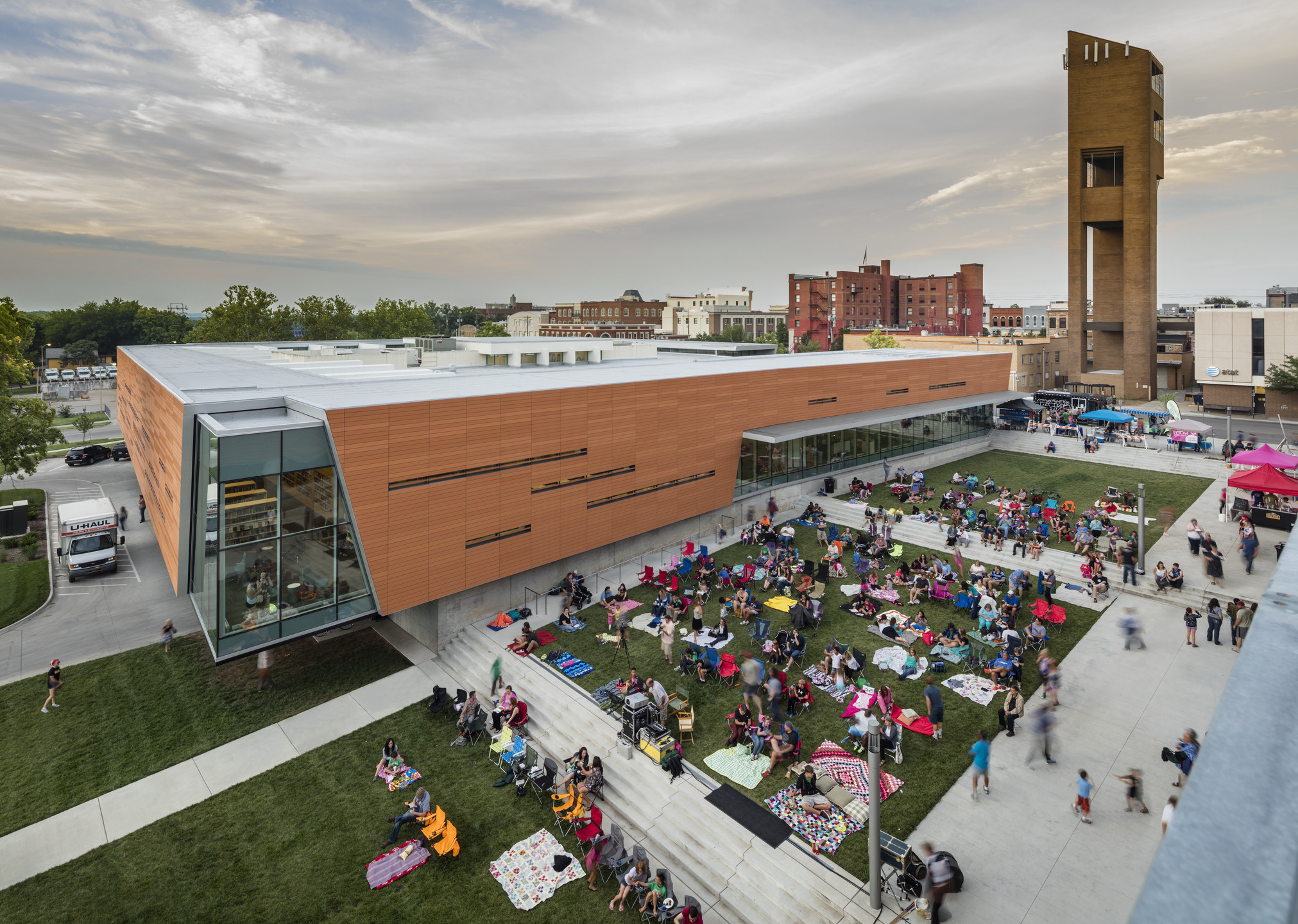
SZ: Back to my reading of modernist literature, I think of John Coltrane’s record Ascension and his movement toward dissonance, along with the abstract expressionists, Joyce’s Ulysses, and the stream of consciousness of Virginia Woolf and other authors. That dissonance was a reframing of the world. These artists altered all the rules that define value and how we think, changing our point of reference.
I ascribe to the idea that once we change our point of reference, we have design freedom. This is an important differentiator in the Midwest: we don't have the histories of the coasts. Operating from new perspectives is inherent in who we are. We’ve always had an environment where we’ve been able to dive in and experiment and engage on a level that allows our team to explore deeper lines of inquiry. From Gould Evans, until now, at Multistudio, we’ve never been hierarchical or prescriptive in our approach. We’ve always been exploring the fringes and edges of design and challenging ourselves.
This allows us to respond to a client’s needs more intentionally and see where that takes us. I do think this is a distinction. In dialogue with stakeholders, we take time to explore their needs and objectives. We understand project aspirations at a deeper level and create concepts that carry significant meaning.
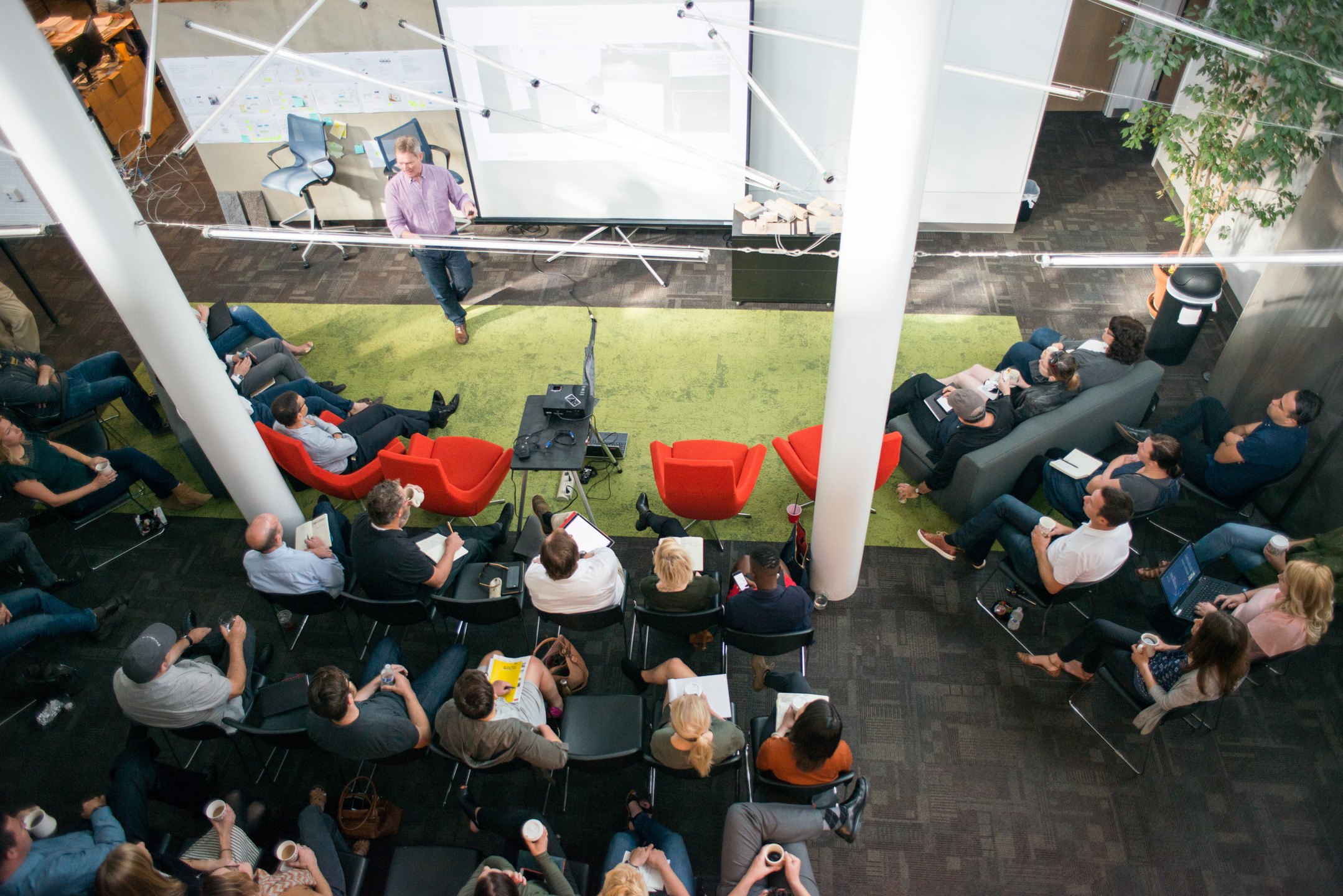
SZ: Our work on the Missouri Innovation Campus was a dialogue about what it means to build a campus today and how we consider the voices of students. One of the key takeaways from students there was a desire to come to school to create projects on their own. However, the way that schools are typically organized, they were only able to be in certain classrooms if a teacher was present. We imagined a school where you could have one teacher connected to multiple rooms. We got rid of all the walls inside and created this campus that empowers students to be able to work outside of the constraints that a typical school building provides.
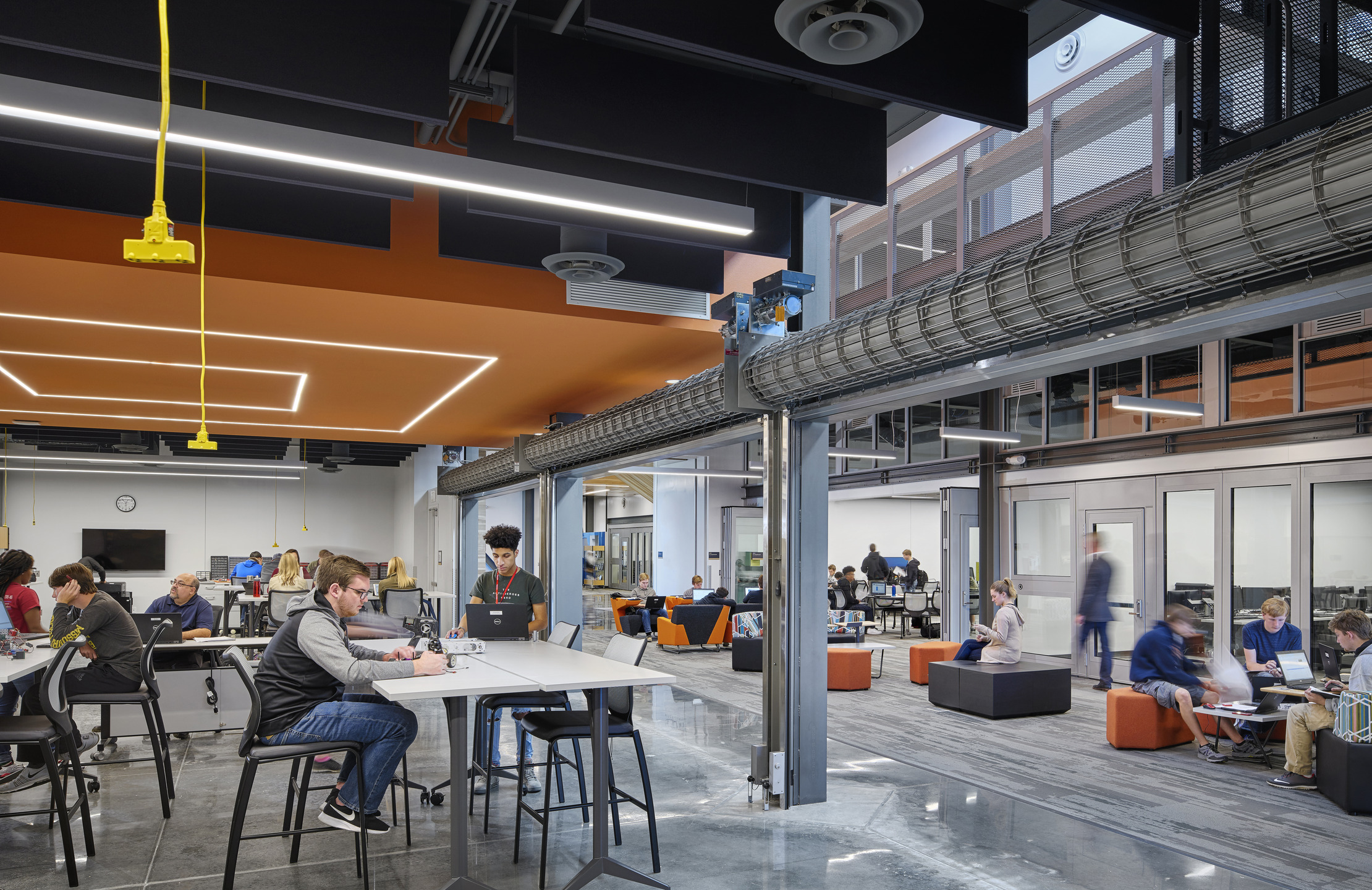
During our work on the Lawrence Public Library, the director of the library and I spent an afternoon driving around libraries in Northeast Kansas. We had these long conversations, which helped me understand his interest in mid-century modern design. He felt this era projected a sense of possibility and hope. As we approached the design concept, we thought about how each of the corners of the building could become opportunities to connect with the community in an experiential way. At each corner, visitors would have a vista that connected them to the downtown, a park, a swimming pool, or the entry to the building. The notion was that every pathway would end in light and serve as a symbol of hope.
SZ: Our Lawrence Public Library project had a strong emphasis on sustainable design. Before we designed anything, we did an energy model of the building. Our goal was to achieve the maximum amount of energy reduction that we could create with an addition. The model told us that we could potentially reduce the building’s energy use by half while still adding 50% to the building.
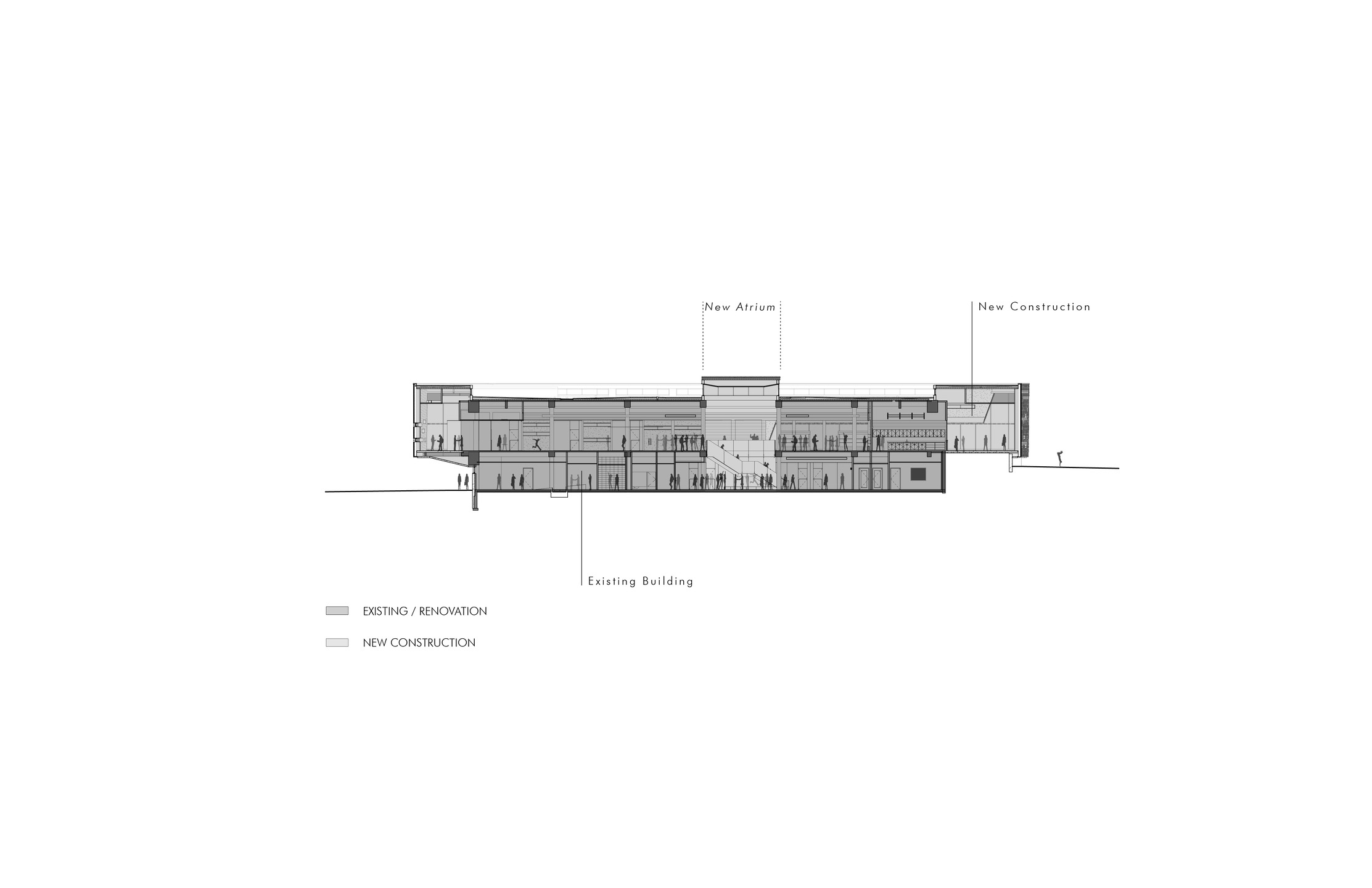
From this work, we gained highly prescriptive information related to the amount of glass, insulation, roofing material, and daylighting to provide on every facade. We learned how every facade could be tailored specifically to its orientation and how it would respond to both solar heat gain and heat loss. The facade designs were essentially based on adjusting the glazing ratios of the openings to create the most balanced and sustainable energy response.
If we go back to the notion that parts of a building are their own languages, we took the information gained from our energy model and imagined that each facade would become a response to the community. We’d take the solar aperture as the variable, and adjust it as we moved around the building: increasing it where it wanted to connect to a park, and decreasing it where it was on a streetscape, or where we wanted children or readers to have a little more autonomy.
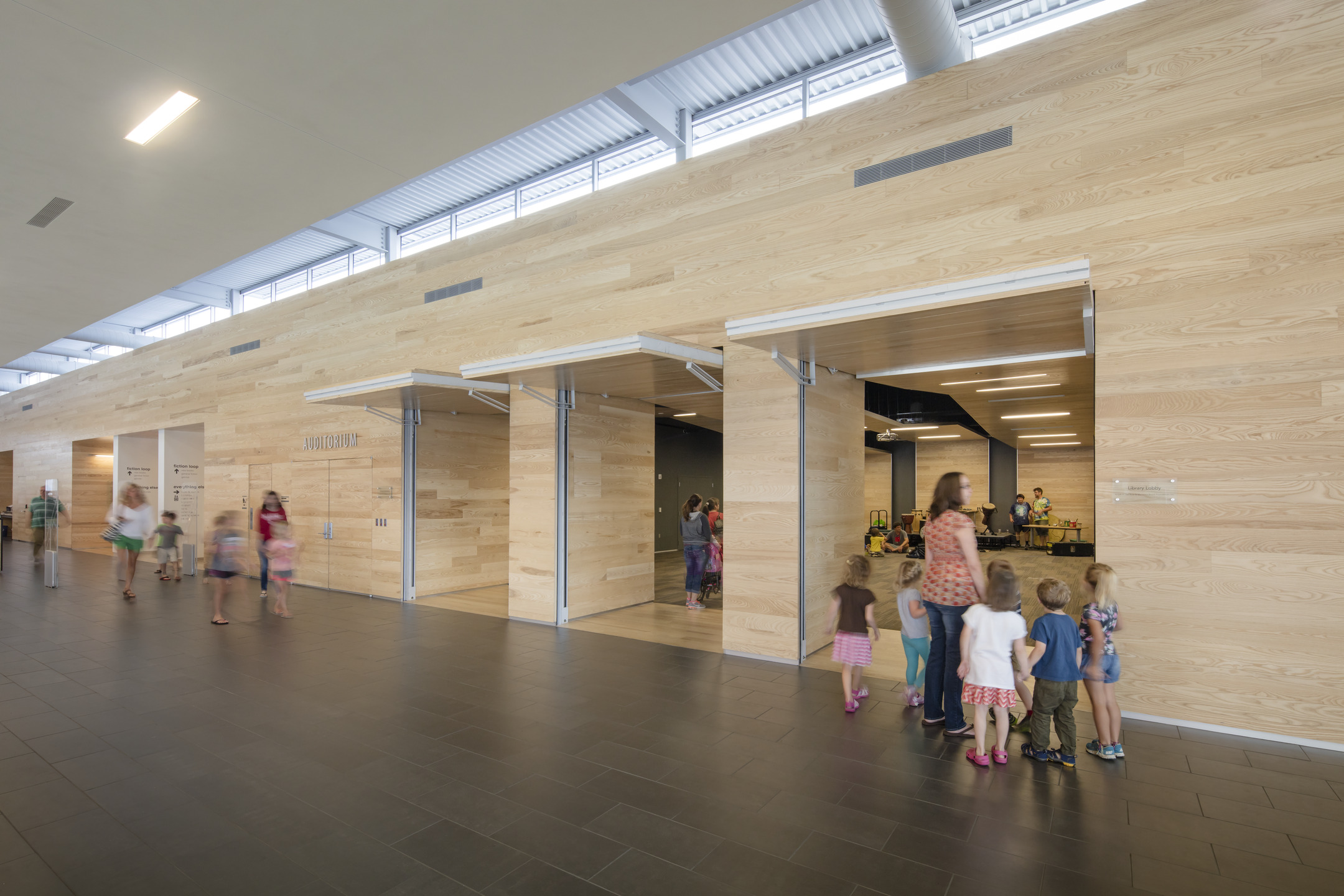
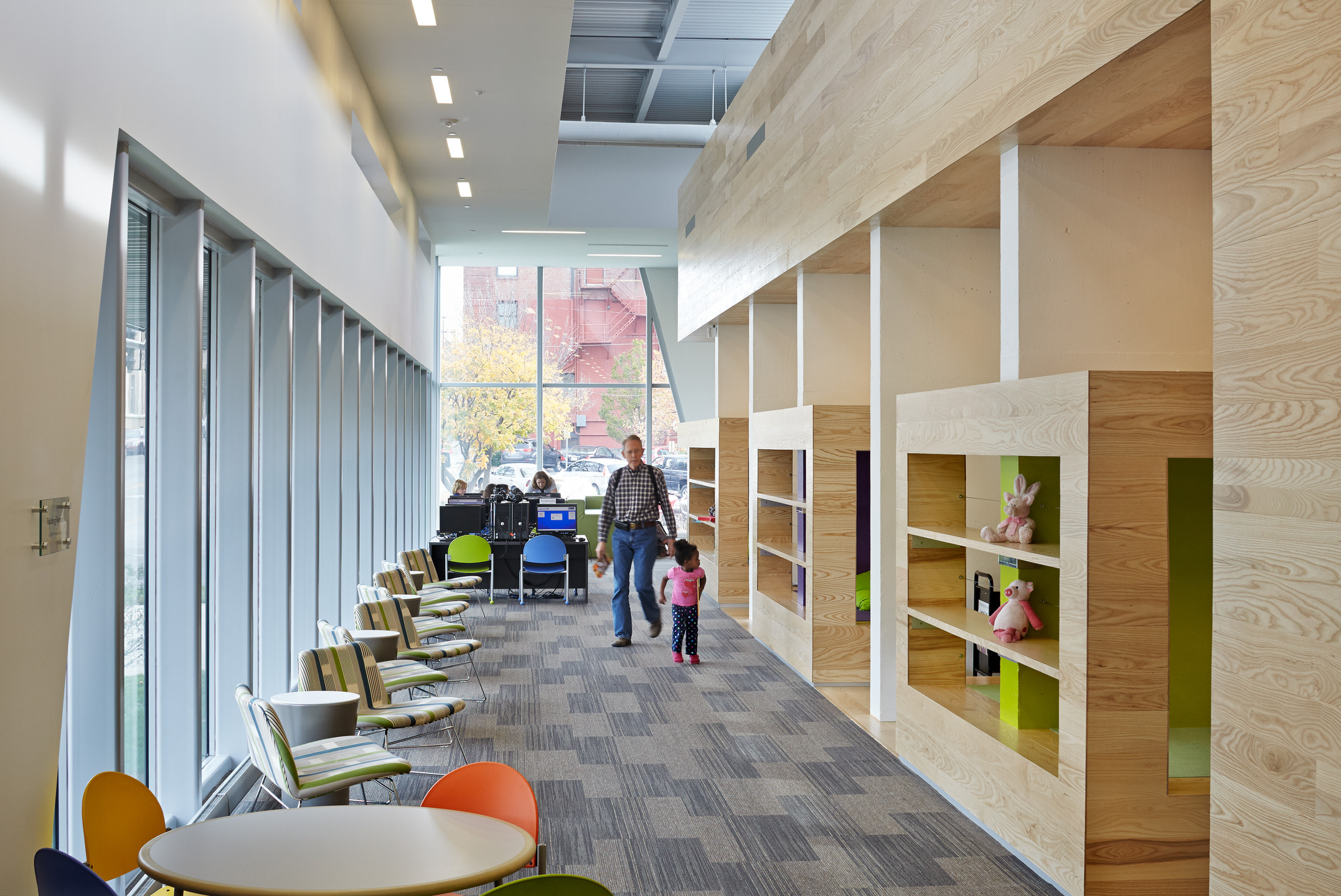
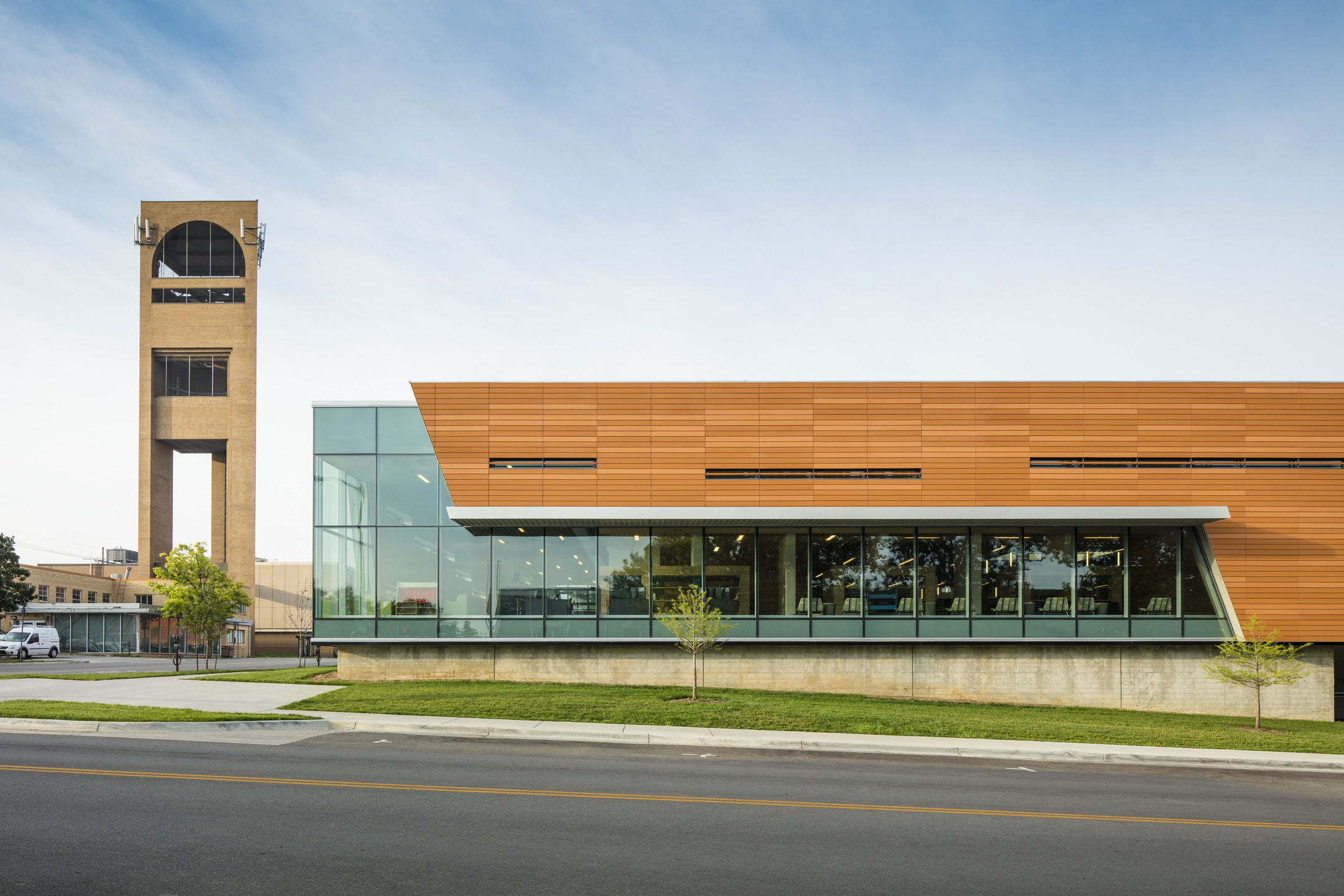
One of the things I learned on that project that was so eye-opening was how we experience daylight and the discomfort of glare. Although we were playing with filtering daylight and letting the facade be this permeable membrane that wrapped around it, we included a clerestory of light on the opposite side of the wall, so we could illuminate the exterior wall with natural light as well. This allowed us to minimize glare throughout the entire interior while still having a very bright environment. It’s fascinating that we can create a sustainable response by using daylight as a tool.
Importantly, our analysis of daylight and glare also had a meaningful experiential effect: rather than making it feel like we were building on top of an existing structure, we purposefully draped the facade over it, so it kind of hovers all the way around the building and sits on top. It never really touches it. There’s always glass in between. It’s always floating, almost like a curtain. And the curtain unveils the community.
View the award-winning cultural, civic, and education projects mentioned in this conversation, including the Lawrence Public Library, the State Historical Society of Missouri Center for Missouri Studies, the Missouri Innovation Campus, and more.
Stay updated on Sean Zaudke’s work by following him on LinkedIn.
